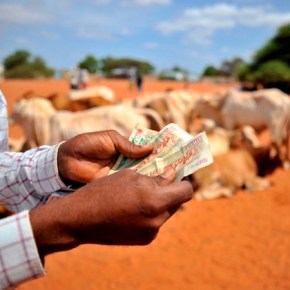
Marsabit District — The first thing that hits a visitor to Ginda village in northern Kenya is the smell. Farmer Haro Sora’s land is littered with the carcasses of cattle and donkeys that have collapsed following an intense, prolonged drought. A skull here; half a ribcage there. In some places there are whole animals slumped … Continue reading
Category Archives: About IBLI
Pioneering insurance for remote livestock herders taking hold in drought-prone areas of Kenya and Ethiopia
Laurie Goering, a reporter for AlertNet writing from the United Nations climate change meetings in Durban this week, says that pioneering insurance projects are giving remote pastoral livestock herders a way to reduce the risks they face from a changing climate that presents recurring, dramatically severe, droughts. ‘Equipping illiterate migratory herders with drought insurance in one … Continue reading
Insurance aims to help herders avoid ‘downward spiral’ from drought
DURBAN, South Africa (AlertNet) – Equipping illiterate migratory herders with drought insurance in one of the driest regions of drought-prone East Africa might seem a big task, particularly in a region where claims adjustors, cell phone coverage and cash to pay for policies are nearly as rare as rain itself. But a range of such … Continue reading
Economist helps devise livestock insurance for drought-stricken Africa
Herdsmen in drought-stricken Kenya have received their first payments from an innovative livestock insurance program designed with the help of Michael Carter, a professor of agricultural and resource economics. The program, intended to prevent livestock producers from falling into indigence and food-aid dependence, could be a model for improving food security in other areas of … Continue reading
New plan for drought victims pays out
MARSABIT, Kenya — “We have never experienced a season like this one,” said Boru Sora, a 25-year old herder of the Borana tribe in northern Kenya. “Sixty of our cattle died this year out of 120, 17 more were taken by raiders, but the main reason? It is hunger and weakness that kills them. It … Continue reading
IBLI project leader Dr. Andrew Mude interviewed on CNBC Africa television: ‘Increase investments in the pastoral livelihood’
As hunger spreads among more than 12 million people in the Horn of Africa, a study by the International Livestock Research Institute of the response to Kenya’s last devastating drought, in 2008-2009, finds that investments aimed at increasing the mobility of livestock herders could be the key to averting future food crises in arid lands. … Continue reading
Kenyan farmers may soon receive first drought payout
Farmers who signed up to a livestock insurance scheme could receive their first payments, after the worst drought in the region for 60 years Insurers will assess in October whether Kenyan farmers signed up to the index-based livestock insurance scheme will receive their first payment, after the worst drought in the region for 60 years. … Continue reading
Kenya: Farmers may soon receive first drought payout
Nairobi — Insurers will assess in October whether Kenyan farmers signed up to the Index-Based Livestock Insurance scheme will receive their first payment, after the worst drought in the region for 60 years. The scheme, which has been piloted in northern Kenya since early 2010, uses freely-available satellite data to assess the state of pastures. … Continue reading
IBLI wins ICT Innovation Award
This week, we won a V2030 ICT Innovation Award from the Kenya ICT Board. The announcement said that the “Index-based livestock insurance (IBLI) is a promising and exciting innovation in insurance design that allows the risk-management benefits of insurance to be made available to poor and remote clients. The IBLI product being piloted in Marsabit … Continue reading
Overview
Since 2011, ILRI and its partners in the public, private and non-profit sectors have pursued a comprehensive research agenda aimed at designing, developing and implementing market mediated index-based insurance to protect livestock keepers from drought related asset losses, particularly those in the drought prone Arid and Semi-Arid Lands (ASALs). Continue reading